Started From the Pit Lane, Won Anyway: The Maddest Finishes in the History of the 24 Hours of Spa
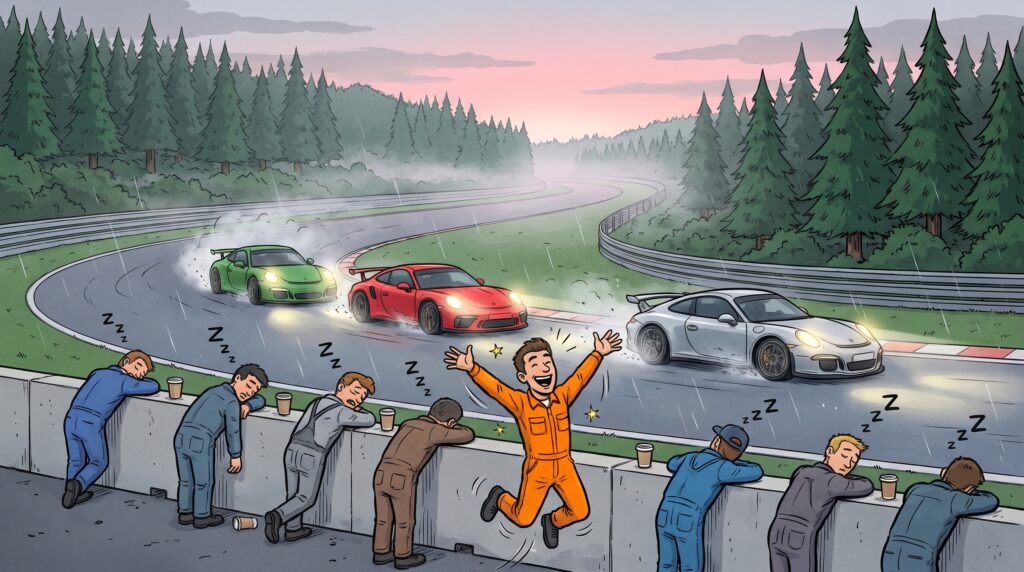
Illustration: AI-generated (Google Gemini). Invented characters, not real people.
Twenty-four hours, seven kilometres of Belgian forest, around seventy cars, and at the end of it the winner is regularly decided by less time than it takes to read this sentence. The 24 Hours of Spa has become the closest big race in the world. This year a Porsche started it from the pit lane and still won. Here is how that happened, and the finishes it now sits alongside.
The 60-second read
- 2026: the Lionspeed GP Porsche of Thomas Preining, Ricardo Feller and Bastian Buus won by 12.288 seconds after starting from the pit lane.
- The closest of the modern era: 3.347 seconds, in 2019, between two Porsches.
- The run: six of the last eight races have been won by under 13 seconds.
- The records: BMW has 25 overall wins. Eric van de Poele has five as a driver.
- The oldest record: the distance mark has stood since 1972, set in a Ford Capri.
- Next: 26 and 27 June 2027, with a certain four-time Formula 1 champion saying he would like to be there.
A race one year younger than Le Mans
The 24 Hours of Spa was dreamed up by two Belgians, Jules de Their and Henri Langlois Van Ophem, and first run in 1924, a year after Le Mans had the same idea. The original circuit was a 15-kilometre triangle of public roads joining the villages of Francorchamps, Malmedy and Stavelot. It was fast, narrow and lined with things you would not want to hit.
For most of its life this was a touring car race. Saloons, not supercars. It was a round of the European Touring Car Championship for much of the 1960s, 70s and 80s, and the names on the trophy from that era are BMW, Ford and Alfa Romeo. The shorter modern circuit, a touch over seven kilometres, arrived in 1979. GT cars took over in 2001, and since 2016 the race has been the centrepiece of an intercontinental GT series as well as the biggest date in GT World Challenge Europe. It marked its centenary in 2024.
One record survives from the old roads. In 1972 Jochen Mass and Hans-Joachim Stuck covered 4,498 kilometres in a Ford Capri on the long circuit. More than half a century and several generations of racing car later, nobody has gone further in 24 hours here. The modern cars are quicker. The modern race just has far more safety cars in it.
The 2026 race: pit lane to first, via the pit wall
On the Thursday of race week in June, the number 80 Lionspeed Porsche needed an unscheduled engine change. That cost it its grid position. When 69 cars took the start on Saturday, it was not among them. It left from the pit lane, second from last.
What followed was 24 hours of patience. Through the night the car climbed the order, helped by a string of full-course yellows and safety cars that kept bunching the field. Around the sixteenth hour Preining took the lead from the pole-sitting AF Corse Ferrari in traffic at the Bus Stop chicane, only for a neutralisation to hand it to the Mercedes of Maro Engel, Lucas Auer and Luca Stolz.
The winning move was made by the people with the laptops. With about five and a half hours left, according to the organisers’ own report, Lionspeed pitted early from third place and jumped both the Mercedes and another Porsche through the stops. Preining pulled clear at the eleventh restart of the race, and the car stayed in front through the final round of pit stops.
At the flag it was 12.288 seconds to the Mercedes, with the Ferrari and a second Porsche right behind. Second, third and fourth were covered by 1.4 seconds after a full day of racing. It was Porsche’s ninth overall win at Spa and Lionspeed’s first. Feller’s verdict, via Porsche: I’m very relieved and incredibly proud of the whole team.
A crowd of 132,000 watched it, which the organisers called a record.
How the pit-lane Porsche won
- ThursdayAn unscheduled engine change costs the number 80 its grid slot
- Saturday startIt leaves from the pit lane, second from last of 69 cars
- NightIt climbs the order through repeated safety cars
- Around hour 16Preining passes the leading Ferrari at the Bus Stop. A neutralisation hands the lead to the Mercedes
- About 5.5 hours to goAn early stop from third jumps the Mercedes and a rival Porsche
- Final hoursPreining pulls away at the eleventh restart
- FlagThe Porsche wins by 12.288 seconds after 541 laps
Why that is not as mad as it sounds
Starting from the pit lane and winning a 24-hour race sounds like a miracle. At Spa it is closer to a strategy. The race now runs with so many neutralisations that track position early on is worth very little. Eleven restarts means eleven occasions on which every gap in the field was wiped out. A fast car that stays out of trouble will be back in contention by breakfast whether it started first or sixty-eighth.
What you cannot recover from is damage, and that is what did for the favourites. The pole-sitting Ferrari suffered two punctures and picked up penalties. The Mercedes lost around three seconds behind a lapped car at the final restart, in a race it lost by twelve. The Lionspeed car’s great trick was that nothing happened to it after Thursday.
And notice who was driving. Feller and Buus went on to win this year’s Sprint Cup title. The Mercedes crew they beat won the Endurance Cup and the overall championship. This was not a lucky outsider. It was the two best crews of the season, separated by a pit stop.
The closest finishes of the GT era
Winning margin in seconds after 24 hours. Bar colour shows the winning make.
Seven finishes, and the stories inside them
Every bar on that chart is a full day of racing reduced to a gap you could hold your breath through. Each has a tale.
2019, 3.347 seconds. The closest of the lot, and the strangest. Rain stopped the race for more than five hours. When it resumed, the GPX Racing Porsche of Kevin Estre, Michael Christensen and Richard Lietz beat another Porsche in a sprint to the flag. Only 363 laps were completed, the shortest distance of the GT era, from a record 72 starters.
2021, 3.978 seconds. Alessandro Pier Guidi hunted down and passed a WRT Audi late on to give Ferrari its first overall win here since 2004. It was also the longest modern race, at 556 laps.
2020, 4.687 seconds. The pandemic race, moved from July to late October and run with no spectators in the cold and dark. A Rowe Racing Porsche won it, with a record eight cars still on the lead lap at the end.
2014, 7.077 seconds. Rene Rast in a WRT Audi wiped out a 20-second deficit in the final 40 minutes. If you ever need to explain to someone what a closing stint is, show them this.
2025, 8.703 seconds. The cruel one. A Porsche was leading when it picked up a puncture at Blanchimont, one of the fastest corners on the circuit. The Grasser Lamborghini of Mirko Bortolotti, Jordan Pepper and Luca Engstler swept through to give Lamborghini its first win at Spa.
Add 2023, when a Rowe BMW won by 11 seconds, and this year’s race, and you get the pattern. Six of the last eight editions have been settled by less than 13 seconds. The exceptions were 2022 and 2024, both won by about half a minute, which in this company counts as a walkover.
Why it keeps happening
Three reasons. First, the cars. Every make is balanced against the others by the organisers, so a Porsche, a Ferrari, a Mercedes and a BMW lap within tenths of each other. Second, the numbers: with around seventy cars on a seven-kilometre track, there is an incident somewhere roughly every time you put the kettle on, and each one closes the field up. Third, the drivers. The front-running cars are crewed entirely by professionals who can run qualifying pace at four in the morning.
Put those together and you get a 24-hour race that behaves like a series of short ones, with the last one starting about an hour from the end. Purists grumble that it is less a test of endurance than it used to be. They have a point. They also keep watching.
Most overall wins by make
Overall victories since 1924. Porsche's total includes 2026.
The record book belongs to Munich
That chart is the touring car era talking. BMW has won this race 25 times, more than the next three makes combined, and most of those came when Spa was a saloon car race and BMW built the best saloons. Its most recent win was in 2023. Porsche’s ninth, this June, was its first since 2020, and it is still 16 short.
The drivers’ record is from the same period. Eric van de Poele won five times, ahead of fellow Belgians Jean-Michel Martin and Thierry Tassin on four each. The modern era makes that harder to match, because the grid is so deep that nobody dominates. Philipp Eng took his third win in 2023, which is as close as anyone current has come.
There is a nice recent footnote. In 2024, the centenary year, Belgian team Comtoyou won with an Aston Martin. It was the first victory for a Belgian team since 2015, and the first for Aston Martin since 1948. Some waits are longer than others.
And next year, possibly, Max
The 2027 race is on 26 and 27 June, and there may be an extra name on the entry list. Max Verstappen runs his own GT team, which won two Sprint Cup races this year with a Mercedes-AMG. Its car retired from the 2026 Spa 24 Hours with overheating, without him in it. He made his own series debut at Portimao in October, and back in September he described Spa as an exciting option for 2027, as Sportscar365 reported. Nothing is entered and nothing is confirmed. But the Formula 1 calendar leaves the weekend free, and he has never been shy about where his heart is.
Elsewhere, the 2027 GT World Challenge Europe calendar runs to ten rounds, with Imola replacing Monza and the Hungaroring replacing Portimao. Walkenhorst is returning with two Aston Martins. The grid for June should be as big as ever.
Le Mans has the history and the glamour. Spa has the finishes. There is no other race on earth where seventy cars can go flat out for a day and a night and the result still comes down to whose engineer blinked first on Sunday morning. If a car can start from the pit lane and win it, the lesson for everyone else is simple and slightly alarming: at Spa, you are never out of it, and you are never safe.
Sources: SRO: Lionspeed GP Porsche takes record-breaking win, Porsche Newsroom: Lionspeed GP wins the 24 Hours of Spa, Autosport: Porsche wins after pitlane start, Motorsport.com: Lionspeed Porsche wins after starting from pit lane, 24 Hours of Spa: The GT3 years in review, 2019, GT World Challenge Europe: the 2021 race in facts and figures, Autosport: Audi wins Spa 24 Hours by seven seconds, Autosport: Lamborghini takes maiden victory, Wikipedia: 24 Hours of Spa, Sportscar365: Verstappen on the Spa 24 Hours, GT Report: 2027 GT World Challenge Europe calendar, Dailysportscar: Walkenhorst set to return.
Start the argument
Be decent. A first comment is checked before it appears.