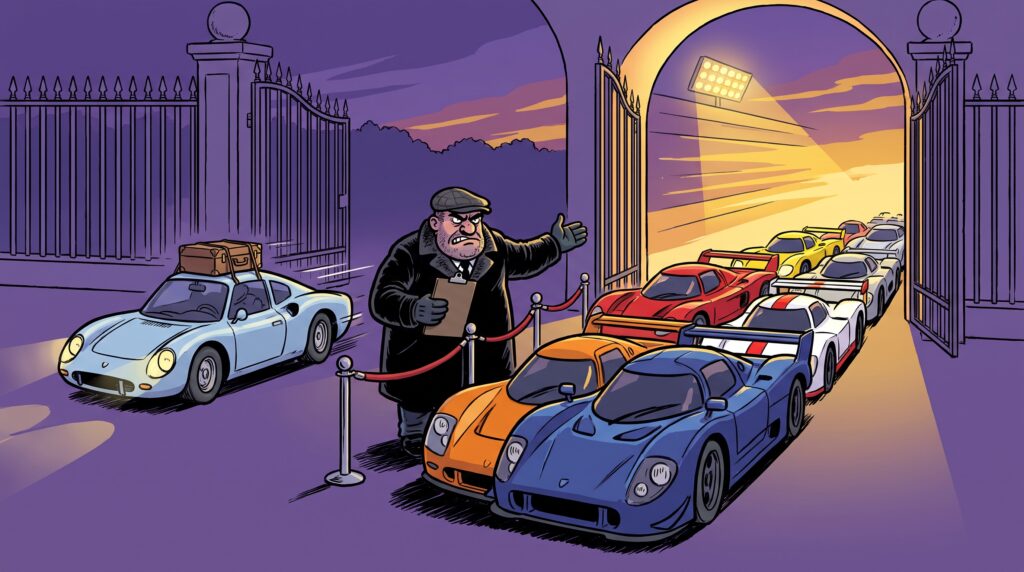
Ford and McLaren Are Coming, Alpine Is Going, and Somebody Has a Week to Save Two Race Cars: Le Mans 2027 Explained
Illustration: AI-generated (Google Gemini). Invented characters, not real people.
The 2026 endurance season ended eight days ago and the 2027 one is already a soap opera. Ford and McLaren are coming to Le Mans. Alpine is leaving it. Porsche is still sulking in the car park. Ferrari and BMW are arguing about the rules for 2030. And one French team has until Monday to find a car maker willing to adopt two orphaned prototypes.
The 60-second read
- Arriving: Ford and McLaren join the top class in 2027, each with six drivers already named.
- Leaving: Alpine has quit. Signatech, which ran its cars, is hunting for a new manufacturer before the 23 November entry deadline.
- Staying away: Porsche, which pulled its factory team after 2025.
- The grid: nine manufacturers by our count: Toyota, Ferrari, Cadillac, BMW, Peugeot, Aston Martin, Genesis, Ford and McLaren.
- The race: the 24 Hours of Le Mans is on 12 and 13 June 2027, round five of nine.
- The row: Ferrari wants performance balancing scrapped from 2030. BMW says that would wreck the whole thing.
Where 2026 left us
Toyota won everything that was not nailed down. The number 8 car of Sebastien Buemi, Brendon Hartley and Ryo Hirakawa took the drivers’ title at the Monza finale on 8 November, having won three of the eight races. The manufacturers’ crown was already settled a round earlier in Barcelona. Hirakawa summed it up for RACER: We came with a new package and won everything.
That included Le Mans, though not without a family argument. In June the sister number 7 Toyota of Mike Conway, Kamui Kobayashi and Nyck de Vries won from the middle of the grid, ending Ferrari’s run of three straight victories, after a Sunday morning team-orders episode that we covered at the time. Sixty-two cars started, 18 of them in the top class.
It was also a season knocked about by events far from any racetrack. Both Gulf rounds, Qatar and Bahrain, were cancelled in July because of the conflict in the region, with Barcelona and Monza brought in to replace them. Monza gave Cadillac a win and gave Alpine a second place in its final race. More on that farewell in a moment.
Final 2026 manufacturers' standings
Hypercar manufacturers' points after eight rounds, from the FIA table.
What the table says about who should be worried
Start at the top. Toyota finished 43 points clear with a car that is, in its bones, several years old, heavily updated for this season. Everyone else had a rules-mandated chance to catch up and did not. BMW in second is the real mover: two wins and pole position at Le Mans. Ferrari in third will consider that a bad year, which tells you where Ferrari’s expectations now sit.
Now the awkward middle. Alpine scored 122 points, finished fifth, ended its last race on the podium, and is leaving anyway. It beat Aston Martin and Peugeot combined. If you want a picture of how car companies make decisions, there it is: the programme was working and the accountants still won.
At the bottom, three teams with different excuses. Genesis was in its first season and took a pole position in Barcelona, so 14 points is a start. Aston Martin’s Valkyrie, the best-sounding car on the grid, still has no podium after losing third place at Monza to post-race penalties. And Peugeot has been at this since 2022 without a win. An evolved car is promised for 2027. Peugeot has promised things before.
Who is coming
Ford. The last time Ford won Le Mans outright, the cars were GT40s and the photographs were black and white. It returns to the top class in 2027 with a prototype built on an ORECA chassis and powered by a 5.4-litre V8, which first ran at Paul Ricard late in the summer. The six drivers are Matt Campbell, Tom Blomqvist, Nick Yelloly, Logan Sargeant, Sebastian Priaulx and Mike Rockenfeller. Who shares with whom has not been announced.
McLaren. Winner in 1995, and not seen fighting for the overall win for a generation. Its new car is built with Dallara, and the driver line-up was completed on 9 November when Malthe Jakobsen joined Laurens Vanthoor, Alex Lynn, Leonardo Fornaroli, Gregoire Saucy and Mikkel Jensen. Lando Norris has had a go in testing, which will do the ticket sales no harm.
Both arrive with customer-style cars built to the simpler of the two rulebooks, the same route BMW and Cadillac took. Both have chosen experience over glamour in the cockpit. Neither will expect to win in June. Both will be furious if they are slow.
Who is going, and who is clinging on
Alpine announced on 12 February that it would stop after 2026 to concentrate on Formula 1. The team that actually ran the cars, Signatech, has no intention of going quietly. Its boss Philippe Sinault wants to keep the two prototypes racing under another manufacturer’s name. Talks with Honda ended before Le Mans. Talks with Geely collapsed in October. He is now down to one unnamed car maker and one week.
The entry deadline for the top class is Monday 23 November. Sinault’s description of the situation to RACER was five words long: We are in an emergency.
The fallback is to drop down to the second-tier class in the European series and try again for 2028, which he has called the more realistic target.
And Porsche? Still out. The factory team withdrew after 2025 and there is no sign of a 2027 return. Its drivers have scattered: one of its biggest names, Kevin Estre, is widely reported to be heading to Toyota, though nothing has been announced.
The ones in between
Toyota has to rebuild a crew. Conway has retired, and Autosport reports that Kobayashi is stepping back from driving the number 7. No 2027 line-up has been published, hence the Estre talk.
Ferrari has been testing what is described as the biggest update to its car since it first raced in 2023, and has extended three of its drivers. Robert Kubica has left the yellow customer car, and nobody has been named in his place.
Cadillac ended the year with a win and starts the winter with an awkward headline. Sportscar365 reports that Penske is in talks to run a factory Cadillac programme from 2028, with a single-car Le Mans entry in 2027 described as almost certain. That is one outlet’s reporting. JOTA, the British team that currently runs the Cadillacs, says it is very happy with its partner. You would, wouldn’t you.
BMW and Aston Martin have named nobody for 2027 yet.
The 2027 calendar
- 27 MarchQatar 1812km
- 11 April6 Hours of Imola
- 25 April6 Hours of Silverstone
- 15 May6 Hours of Spa-Francorchamps
- 12 and 13 June24 Hours of Le Mans
- 11 July6 Hours of Sao Paulo
- 12 SeptemberLone Star Le Mans in Texas
- 26 September6 Hours of Fuji
- 6 November8 Hours of Bahrain
Nine races, and two of them with an asterisk
The calendar grows from eight rounds to nine. The happy news is Silverstone, back for the first time since the 2019-20 season, on 25 April. A British round with a McLaren on the grid and a Ford with a Priaulx in it is about as easy a sell as this championship has had.
Le Mans keeps its place in the middle, with race day on 12 and 13 June. It is the fifth round, which means four races for the new cars to find their problems before the one that matters.
The asterisks are at either end. The season is scheduled to open in Qatar and close in Bahrain. Both of those races were cancelled in 2026. Bahrain’s contract has been extended to 2036, so the intent is clear. Whether the world cooperates is not something a calendar can promise.
Le Mans 2026: gap to the winning Toyota
Seconds behind the winner after 24 hours, rounded. The winning car completed 381 laps.
Why everyone is arguing about balance
That chart is the best advert the current rules will ever get. After 24 hours, four cars from three manufacturers were covered by 32 seconds. That does not happen by accident. It happens because the organisers adjust the weight and power of every car to keep them close, a system known as Balance of Performance.
It is also the thing the paddock fights about most bitterly, more so since the championship stopped publishing the figures this year. And at Monza the fight went public. Ferrari’s endurance chief Antonello Coletta said that when the series moves to a single type of car in 2030, the balancing should go, telling Sportscar365: the final goal should be for us to delete the BoP
. Let the best car win, in other words.
Five days later BMW’s motorsport boss Andreas Roos replied that balancing has to remain a cornerstone of the rules. His argument: manufacturers signed up on that basis, and without it you get a spending war and an empty grid. Toyota’s technical director David Floury sits somewhere between them, saying a single platform will not solve everything.
Both sides have a point. Ferrari is right that a balanced win always carries a small question mark. BMW is right that the question mark is the price of having nine manufacturers. And it is hard not to notice that the team arguing for pure merit is the one with Ferrari’s budget.
We know how the alternative ends
There is a precedent, and it is recent. In the previous top class, with no balancing between the hybrid factory cars, costs ran away. Audi left after 2016. Porsche left after 2017. For the next few seasons Toyota raced, in effect, against itself, and won Le Mans with nobody of its own size to beat. The current rules were written to make sure that never happened again. They have worked so well that people have forgotten why they exist.
What happens next
Monday 23 November: the entry deadline, and the moment of truth for Signatech. Then the entry list itself. The final text of the 2030 rules, due by the end of this year, has slipped to early 2027 according to Dailysportscar. The cars gather in Qatar for the official test on 21 and 22 March, race there on 27 March, and reach Le Mans in the second week of June.
Nine manufacturers, two famous names coming back and a queue at the door: endurance racing has not been this healthy in half a century. So naturally the people inside are arguing about whether to change the thing that made it healthy. Our advice to the rule-makers is to nod politely at Ferrari and leave the balancing alone. Our advice to any car company with a spare badge and a free weekend is to ring Signatech before Monday.
Sources: FIA: 2026 World Endurance Championship standings, RACER: Quiet WEC title clinches taste just as sweet for Toyota, Autosport: Number 8 Toyota seals drivers’ title at Monza, Autosport: Silverstone added to nine-round 2027 schedule, ACO: 2026 press conference in a nutshell, RACER: Signatech weighs options as Hypercar deadline looms, Sportscar365: Signatech remains in talks with one manufacturer, RACER: Alpine withdrawing from Hypercar, Autosport: Jakobsen completes McLaren’s line-up, RACER: Ford’s Hypercar line-up, Sportscar365: Ferrari calling for BoP to be removed, Sportscar365: Roos says BoP needs to be cornerstone, Dailysportscar: Is Hypercar without BoP possible for 2030, Sportscar365: Penske in frame for factory Cadillac programs, Autosport: A fond farewell to a few WEC favourites, Wikipedia: 2026 24 Hours of Le Mans.
Start the argument
Be decent. A first comment is checked before it appears.